
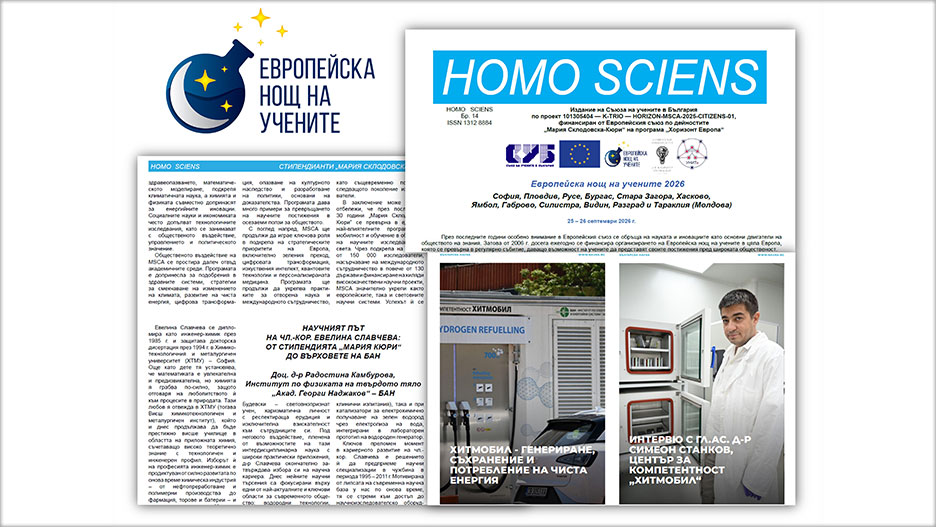
Experts and Research Developments from the Centre of Competence HITMOBIL Featured in Special Issues Marking European Researchers’ Night 2026
Centre of Competence HITMOBIL in the Spotlight in Special Issues of “Homo Sciens” Newspaper and “Bulgarian Science” Magazine
To mark European Researchers’ Night 2026, “Homo Sciens”, a newspaper published by the Union of Scientists in Bulgaria, and “Bulgarian Science”, a magazine published by the “Forum for Science in Bulgaria” Association, released special issues presenting research projects and achievements of scientists from across the country, including experts from the Centre of Competence HITMOBIL.
“Homo Sciens”, Issue 14, 2026 published an article in its “Marie Skłodowska-Curie Fellows” section introducing readers to the scientific and professional development of Corresponding Member Prof. Dr Evelina Slavcheva, President of the Bulgarian Academy of Sciences. The article also presents her work as Head of the Centre of Competence HITMOBIL and a researcher at IEES-BAS, focused on developing research infrastructure and innovative solutions for the production, storage and use of clean energy. Among the highlights is the establishment of the first “Integrated Energy Systems” Field Laboratory in Southeast Europe within the Centre of Competence HITMOBIL, which is becoming an established centre for testing, training and demonstrating hydrogen technologies.
“Bulgarian Science” magazine published a special issue entitled “Centres of Competence and Excellence in Bulgaria”, prominently featuring the article “HITMOBIL – Generation, Storage and Consumption of Clean Energy” and an interview with Chief Assistant Professor Dr Simeon Stankov, an expert at the Centre of Competence HITMOBIL and a researcher at IEES-BAS. The material presents the Centre’s main research and development activities related to creating sustainable energy technologies, as well as Dr Stankov’s perspective on specific developments in advanced rechargeable lithium-ion systems. The interview also presents the work on introducing a production line that will enable the development and validation of new materials and technologies under conditions as close as possible to industrial ones, but on a small production scale.
In Bulgaria, European Researchers’ Night 2026–2027 is being implemented with financial support from the European Union under the Marie Skłodowska-Curie Actions of the Horizon Europe programme through the K-TRIO project (Researchers in the Knowledge Triangle), as well as with support from the team of the UNITE Centre of Excellence project (Universities for Science, Informatics and Technologies in the e-Society), funded by the European Regional Development Fund through the Programme for Research, Innovation and Digitalisation for Smart Transformation.