
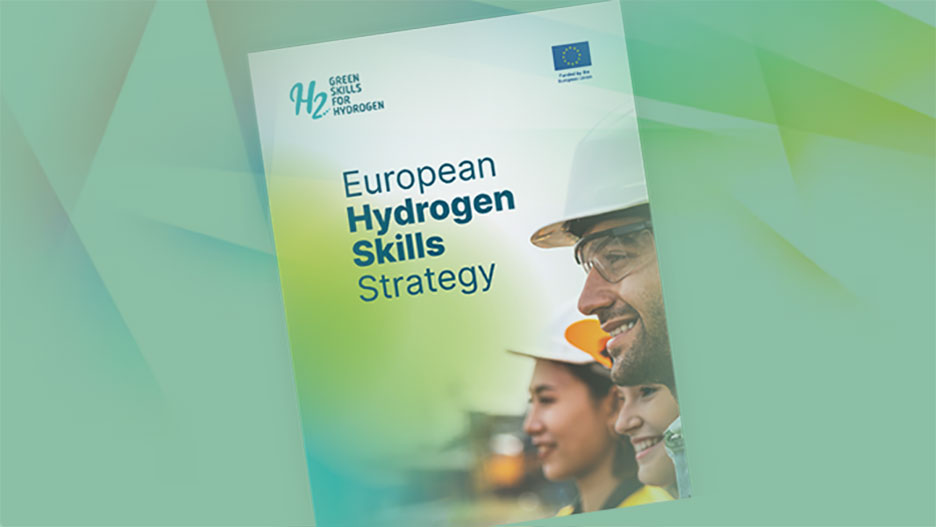
European Strategy for Hydrogen Skills
First training activities in Bulgaria, implemented by IEES-BAS with partners
The European Hydrogen Community has Developed a Strategy for Skills Development in the Hydrogen Sector
Initial training activities in Bulgaria have already been delivered by IEES-BAS with the support of the IUHR at Trakia University and the Center of Competence HITMOBIL
The European Union’s Green Deal has positioned hydrogen as a key element in ensuring clean energy for industry and transport. The emerging hydrogen technology sector is expected to grow significantly. Its sustainable establishment and development require a critical mass of qualified specialists across all levels of the hydrogen value chain, including production, transport, storage, infrastructure, operation, maintenance, and related activities.
The European hydrogen community has developed a European Hydrogen Skills Strategy, a key policy document outlining current and future workforce needs and defining pathways for education and training activities—including the training of trainers—and for the acquisition of qualifications in the rapidly developing hydrogen industry. According to strategic forecasts, by 2030 the hydrogen sector in Europe has the potential to create up to one million new jobs, which necessitates urgent and coordinated action in the fields of education and vocational training.
The European Hydrogen Skills Strategy is the result of a large-scale study conducted between November 2022 and March 2023 by the partners of the Green Skills for Hydrogen project. The document provides a comprehensive overview of human resource needs across the entire hydrogen value chain—from production, through transport and storage, to end-use applications. The analysis is based on a large European survey involving industry representatives, educational institutions, public organisations and professional networks. In total, representatives from 146 stakeholder organisations across 23 EU Member States were surveyed.
The study identified more than 200 key occupational profiles with high demand and analysed the specific “hydrogen-related knowledge” required for these roles.
- The highest demand is observed for technical profiles such as engineers and technicians, particularly those with expertise in chemical processes and industrial engineering; high-voltage electrical energy systems; automation, electronics and electrochemistry (electrolysis and fuel cells); as well as maintenance, technical operation, installation and health, safety and environment (HSE).
- A shortage is also evident among managers, project leaders and public administration professionals responsible for permitting and regulation of hydrogen projects.
According to the assessment of existing training and qualification programmes, many companies currently acquire specialised skills through on-the-job training and short courses. Although the number of highly specialised academic programmes (mainly at Master’s level) in hydrogen for energy applications has increased over the past decade, there remains a lack of sufficient short-term vocational training programmes for professionals who are already employed but seek additional qualifications.
The European Hydrogen Skills Strategy outlines an action plan targeting sectors with declining intensity and/or regions in transition, offering opportunities for upskilling and reskilling within the hydrogen sector.
The strategy defines six strategic pillars for development:
- Development of modular training programmes – flexible courses aligned with industry needs;
- Definition of training and qualification standards – a common framework for individuals with comparable skills that can be recognised across different countries;
- Improved access to lifelong learning (upskilling and reskilling), involving employers and public institutions;
- Creation of an online community – an information hub and database for training programmes, professional roles, standards and good practices;
- Promotion of learner and trainer mobility across countries – to address local shortages of qualified professionals;
- Increasing the attractiveness of the hydrogen sector – by promoting opportunities and raising awareness of clear career paths and social acceptance.
The European Hydrogen Skills Strategy represents an important step towards building a sustainable and competitive hydrogen economy in Europe—an essential component of the green energy transition in the coming decades. The strategy helps align industry needs with educational programmes to ensure the availability of qualified professionals ahead of the expected surge in hydrogen projects. For countries such as Bulgaria, the document provides valuable guidance for the development of national education and vocational training programmes aimed at preparing highly qualified personnel needed for future investments and infrastructure projects in hydrogen energy and transport.
The European Hydrogen Skills Strategy is the first of the core documents developed within the Green Skills for Hydrogen project, co-funded by the European Union’s Erasmus+ programme. The project started in mid-2022 and will run until mid-2026. It focuses on targeted training initiatives aimed at addressing the critical skills gap for hydrogen-related activities in industry. Green Skills for Hydrogen is a consortium led by the Karlsruhe Institute of Technology (KIT), Germany, and includes a total of 34 partners from 15 EU Member States. The partners are organised into six work packages.
From Bulgaria, the project partner is the Institute of Electrochemistry and Energy Systems “Acad. Evgeni Budevski” of the Bulgarian Academy of Sciences (IEES-BAS). IEES-BAS participates in the project’s research activities and delivers introductory training courses aimed at familiarising a wider audience with the hydrogen economy. These activities are implemented with the support of the Institute for the Development of Human Resources at Trakia University, an associated partner in Green Skills for Hydrogen, and the Center of Competence HITMOBIL - a unique infrastructure for Bulgaria and the region, focused on high-level applied research in innovative renewable energy storage systems and electromobility, in close collaboration with industry.
IEES-BAS